

Choosing a CO2 monitor for a workplace wellness programme
A workplace wellness programme usually starts with one question: is the ventilation keeping up with the people in the room? CO₂ answers it. This guide covers what to specify and where each option fits.
Start with the CO₂ channel
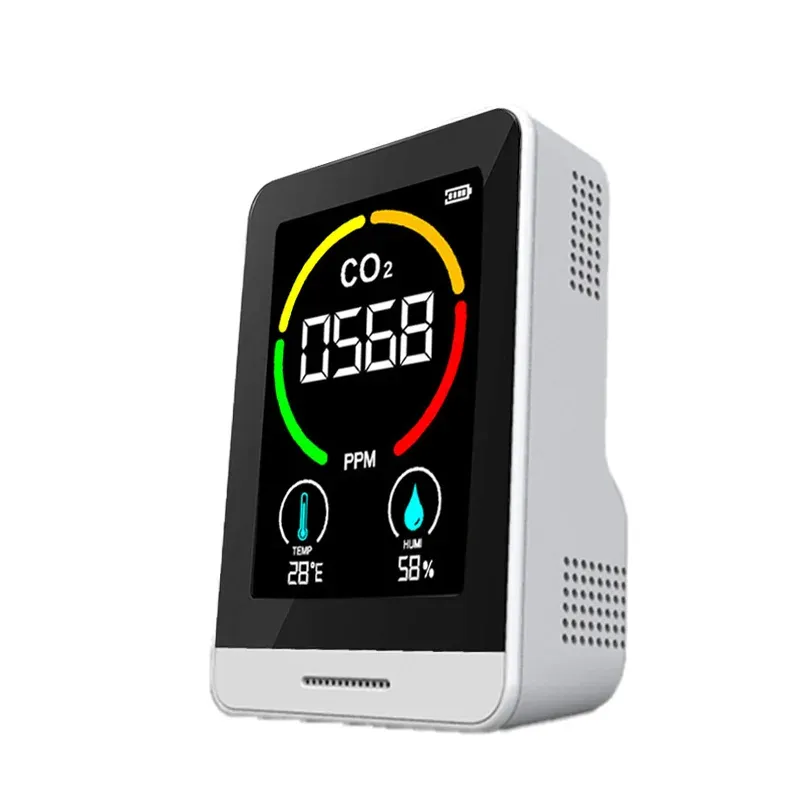
The CO₂ sensor class decides what you can do with the reading. A semiconductor element tracks the rise and fall that tells you to open a window, which is what a classroom or meeting room needs, and the AK11T is the entry point in the range for that job.
Infrared NDIR responds to CO₂ and nothing else, so cooking vapour, hand sanitiser and air freshener leave the reading untouched. Infrared measurement also does not age the way a semiconductor element does, so a figure taken next winter can be set against one taken today.
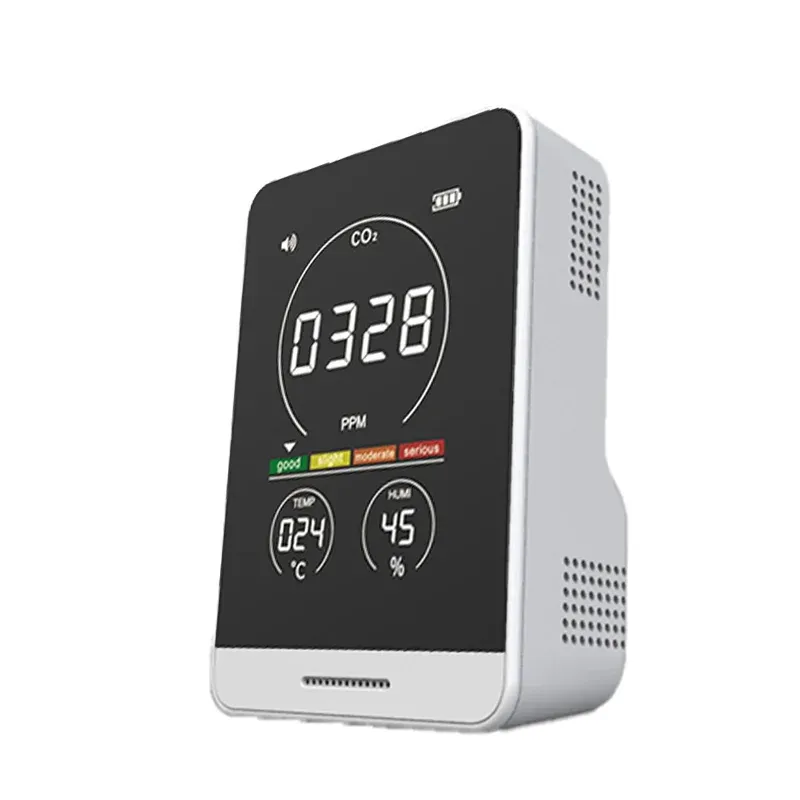
If your programme needs a number you can put in a ventilation assessment, specify NDIR. The AK4 keeps the same five readings as the AK3 and changes only the CO₂ channel. The AK11H is the same upgrade inside the AK11 shell.
- Single-parameter NDIR: AK8, AK11H
- NDIR with five readings: AK4, AK25AH
- Semiconductor CO₂ for occupancy trends: AK11T, AK3
Match the parameter list to the room
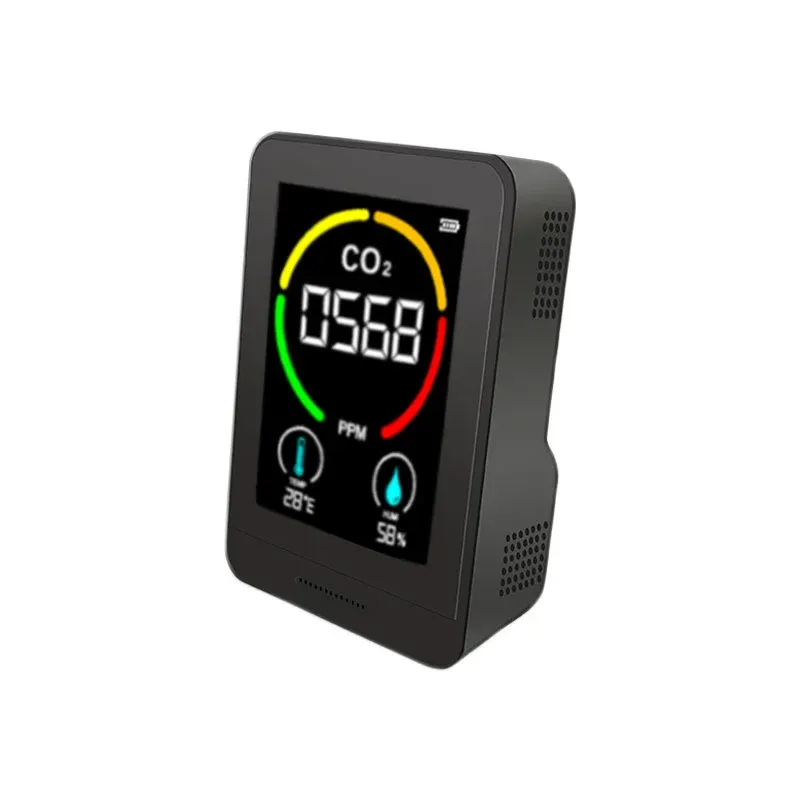
A CO₂-only device is the cleanest proposition when ventilation is the whole question. The AK8 puts one value inside a green-to-amber-to-red arc that fills the screen, with temperature and humidity in two supporting circles underneath.
Where the concern is off-gassing rather than occupancy, the AK11C uses an electrochemical cell that responds to formaldehyde specifically and holds its reading over months rather than hours, with temperature and humidity alongside because formaldehyde release rises sharply with both.
For a full indoor air picture, the AK16A reports CO₂, TVOC, formaldehyde, three particulate fractions, temperature and humidity on a 24 mm panel, and each reading carries its own colour band. The AK16C adds an AQI bar that collapses eight readings into a single figure while keeping all eight underlying values on screen.
Choose the face that suits the room
How the screen is laid out decides whether anyone acts on it. The AK22A tiles six values in a grid with none subordinate, which suits a technician scanning for the one value that has moved. The AK22B puts PM2.5 in a large central ring with a full-width AQI scale beneath, for a lobby or reception desk where people glance rather than study.
The AK23A splits particulates and gases into two dials with a six-step colour scale across the bottom, and its controls sit out of sight so the front panel stays clean. The AK23B gives PM2.5 the centre of the screen at several times the size of anything else, with the remaining values as labelled groups.
Where a desk gets knocked, the AK28A uses a moulded rear wedge for a fixed viewing angle and gives clock, alert, brightness and power a key each.
- Read from across a room: AK22A, AK22B
- Guest-facing with an index: AK16C, AK23A
- Fixed desk angle: AK28A
Plan for logging, siting and power
The AK33 stores its own record on board, so it logs whether anyone is in the room or not and hands the record over later, at 173 g and 25 mm thick. The AK34 records both 24-hour and 15-day trend history.
Siting decides the power arrangement. The AK32A runs on mains indefinitely at 110–240 V with US and EU pin variants, which suits a landlord fitting out many units where installation cost often exceeds hardware cost. The AK30 has an ambient light sensor that drops the backlight as the room darkens, for monitors that share a room with someone asleep.
For walk-around checks, the AK25A packs five readings into a 98 g body, and the AK25AH carries the same five readings with the CO₂ channel moved to infrared NDIR.
Confirm the details per model
Certification and compliance documentation is not uniform across a range, so ask for the product spec sheet of each model you intend to order and check it there before you commit.
The same applies to enclosure and packing decisions. Several models share tooling and carton specifications, which lets you carry two tiers without a second freight arrangement, but you should confirm the exact carton quantity and outer dimensions for each model on its own spec sheet.
That sequence narrows the range to two or three models quickly.