

Choosing an IAQ monitor for a rental property programme
A rental programme puts monitors in many rooms, with no one on site to explain them. This article covers what to plan for when you specify units for that setting.
What the programme has to measure
A rental portfolio rarely has one air problem. Older units may have gas hobs, wood stoves or attached garages, and the AK16D-CO adds an electrochemical CO cell to the AK16 platform for those rooms; it is positioned as a continuous sited monitor with an on-screen alert, and where local rules require a listed CO alarm it sits alongside one rather than replacing it. A pocket CO detector covers the same question in a different way, since the AK18A carries an electrochemical cell in a body of 39 g and sounds an audible and visual alert when the reading crosses the threshold.
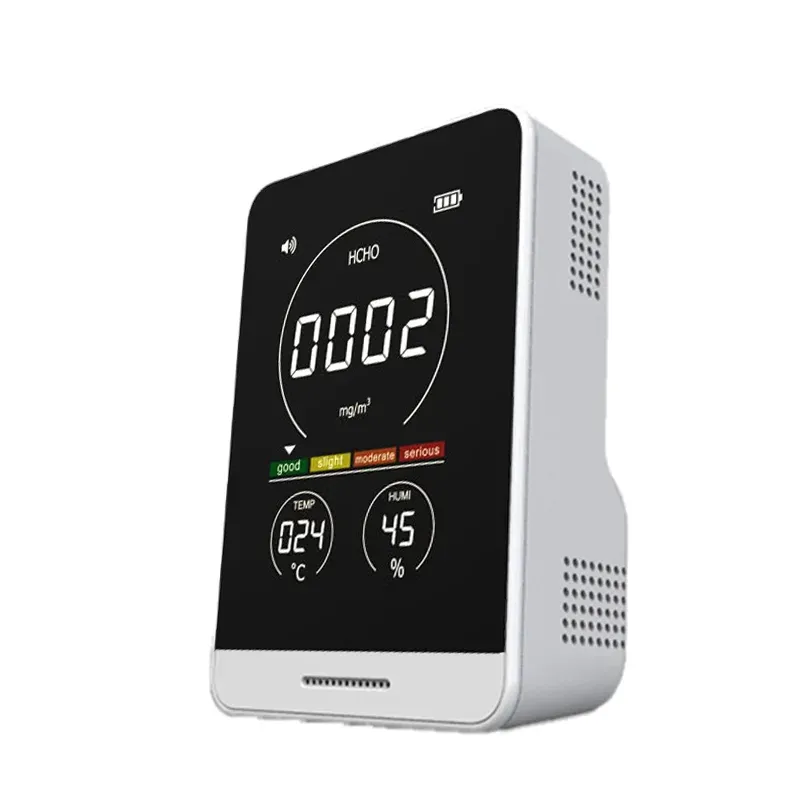
Where the concern is a recent refurbishment rather than combustion, the sensor class matters more than the feature list. The AK11C uses an electrochemical formaldehyde cell rather than a semiconductor element, responds to formaldehyde specifically, and holds its reading over months rather than hours. Its temperature and humidity readings sit alongside because formaldehyde release rises sharply with both, so the two values explain why a level moved.
For rooms where occupancy is the variable, the AK11H reads CO2 by infrared NDIR, which does not age the way a semiconductor element does, so a figure taken next winter can be set against one taken today. The same source notes that alcohol, solvents and cooking vapour move a semiconductor CO2 reading but do not move an infrared one.
- Combustion risk in kitchens, boiler rooms and attached garages: AK16D-CO, AK18A
- Post-renovation formaldehyde: AK11C
- Occupancy and ventilation in shared rooms: AK11H
One face per audience
A rental programme usually has two audiences reading the same device: the tenant, who needs a judgement, and the facilities team, who needs the numbers. The AK16C collapses eight readings into a single 0–500 index with a colour scale, while all eight underlying values stay on screen, so a guest and a facilities manager can read the same unit. The AK23A takes a different route, splitting particulates on the left and gases on the right with a six-step colour and expression scale across the bottom, so a guest interprets the air without interpreting the numbers.
Where a unit is visible in a lobby or reception area, presentation becomes a specification decision rather than a styling one. The AK22B puts PM2.5 in a large central ring with the remaining readings arranged around it and a full-width AQI scale beneath, and shares identical sensing with the AK22A grid face — the difference is entirely in how the information is presented. The AK23B takes the opposite approach, with PM2.5 dominating the centre at several times the size of anything else and the remaining values as labelled groups, readable from a distance no dial layout matches.
The AK28A is the version to specify where a desk gets knocked: four buttons on the front for clock, alert, brightness and power, and a moulded rear wedge that sets the screen at a fixed reading angle without a fold-out leg to snap off.
Placement and power planning
Rental units are not offices, and the two constraints that decide most placements are where a device can sit and how it gets power. The AK25A measures 66.3 × 30.6 × 96 mm at 98 g with five readings, which fits a hotel nightstand, a shelf in a nursery or a car cup holder. The AK25AH carries the same body and the same five readings with the CO2 channel moved to infrared NDIR.
Overnight is when a monitor is most useful and most likely to be unplugged. The AK30 addresses that with an ambient light sensor that drops the backlight as the room darkens, a 5000 mAh battery and eight hours of standby, and it shares its enclosure with the AK29 radon model so a customer can move between them without a change in installation footprint. The AK29 itself adds radon to a parameter set that already includes particulates, CO2, VOC and formaldehyde.
Where a landlord is fitting out many units at once, installation time can exceed the hardware task. The AK32A runs on mains from a socket with 110–240 V and US and EU pin variants, so there is no wiring, bracket or installer involved.
- Nightstand or shelf: AK25A, AK25AH
- Bedrooms and nurseries left running: AK30
- High-volume fit-out with no installer: AK32A
Records and follow-up
A programme that only produces spot readings leaves nothing to act on. The AK33 stores its own record on board rather than depending on a paired handset in the room, at 173 g and 25 mm thick, which supports surveying several rooms in sequence and reading back where the levels changed. The AK34 records both 24-hour and 15-day trend history, which makes pollution patterns and daily changes visible rather than leaving them to recollection.
Where a report has to name rooms and times, on-board history is the difference between a finding and a recollection. That is the workflow a spot-reading monitor cannot support.
Before you commit to a model
Two things belong in your own checklist rather than in a supplier's summary. First, each model's certifications are shown only on its product spec sheet, so check the spec sheet of every model you shortlist rather than assuming the range is uniform. Second, confirm the carton and enclosure relationships across the models you plan to stock, because several share tooling: the AK16A and AK16C use the same enclosure and 30-per-carton spec, the AK22A and AK22B share enclosure and carton spec, and the AK23A and AK23B share enclosure, packaging and a 32-per-carton spec.
Carton density also varies enough to affect how you plan a rollout. The AK22A ships 21 per carton in a 515.5 × 445.5 × 223 mm outer, the AK23A ships 32 per carton in a 500 × 261 × 302 mm outer, and the AK32A ships 120 per carton in a 520 × 505 × 355 mm outer. Grouping models that share a carton spec keeps a mixed pallet simple to plan.
- Check the spec sheet of each shortlisted model for its certifications
- Confirm which models share an enclosure before mixing a pallet
- Compare carton counts across the models you intend to deploy