

Matching the sensor to the room
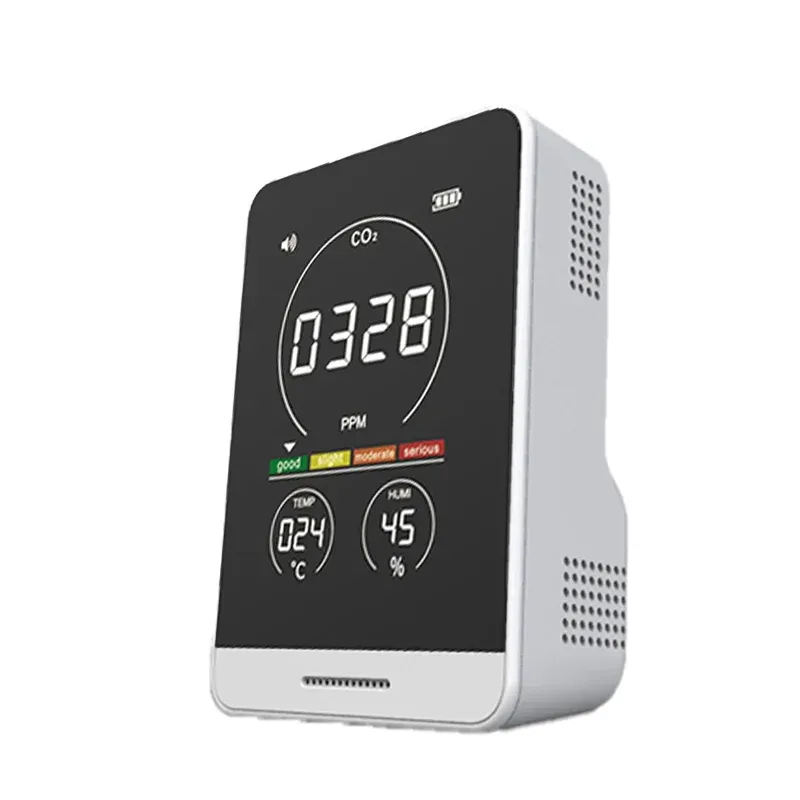
The first decision is what the room is likely to fail on. A semiconductor CO₂ element tracks the rise and fall that tells you to open a door, and the colour bar under the digits moves green to red as the level climbs, so occupants act on the band without learning what 1000 ppm means.
Where a figure has to go into a ventilation assessment, the CO₂ channel needs infrared NDIR. Infrared measurement does not age the way a semiconductor element does, so a figure taken next winter can be set against one taken today, and alcohol, solvents and cooking vapour do not move the reading.
Particles need a different sensor class again. A laser scattering module with a fan-drawn sample path produces a µg/m³ figure worth acting on, and the reading follows in real time, which is what makes cause and effect visible when a door opens or a process starts.
- CO₂ only, occupancy-driven rooms: AK8, AK11T, AK11H.
- Particulates as the primary concern: AK11P, AK27.
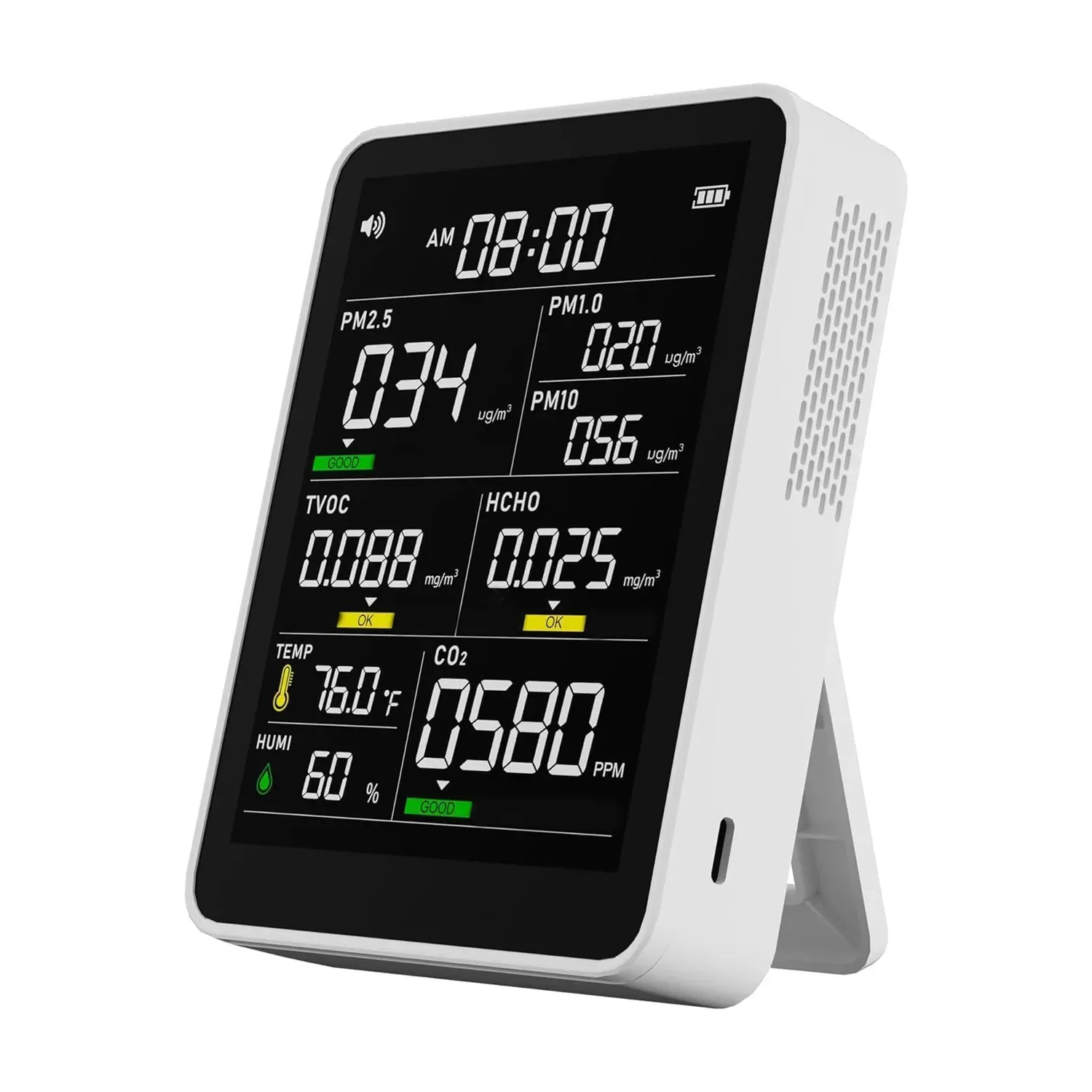
- Mixed gas and particle coverage on one screen: AK16A, AK22A, AK23A.
- Walk-around surveys with a stored record: AK33, AK34.
Fixed positions, carried units and the survey route
Most industrial deployments need two kinds of device, not one. A sited unit answers the same question every day in the same place; a carried unit answers a question in many places. The AK33 stores its own record, so it logs whether anyone is there or not and hands the record over later, which is the difference between a finding and a recollection when a report has to name rooms and times.
The AK34 records both 24-hour and 15-day trend history, which makes pollution patterns and daily changes visible rather than remembered.
For a face that reads from across a bay, the AK22A gives every reading equal weight in a grid, which suits a technician scanning for the one value that has moved. The AK22B puts PM2.5 in a large central ring with the remaining readings around it and a full-width AQI colour scale beneath, so the layout answers whether the air is alright before it answers anything else.
Planning the rollout before the first unit ships
Decide how many parameters each position needs, because that single choice drives enclosure size, carton count and freight. The AK16A carries eight parameters in a body no thicker than a paperback, at 30 pcs per carton. The AK22A is the largest enclosure in the range at 21 pcs per carton, because the display is sized to be read standing up from the other side of a room.
Where a site needs a single index number that anyone can act on, the AK16C collapses eight readings into a single 0–500 figure with a colour scale, while all eight underlying values remain on screen so a facilities manager and a visitor can read the same device.
The AK11 family runs 6–8 hours cordless on a 1200 mAh cell, so a unit that stays in one place needs a charging routine or a socket nearby. The AK30 carries 5000 mAh and eight hours of standby, and an ambient light sensor drops the backlight as the room darkens, which is the configuration for a space where the monitor shares the room with someone asleep.
Gases that are not CO2
Carbon monoxide is colourless and odourless, which is the whole reason it has to be instrumented rather than noticed. The AK16D-CO adds an electrochemical CO cell to the eight-parameter platform, bringing the count to nine measured parameters.
That configuration belongs where combustion happens: kitchens with gas hobs, homes with a wood stove or unvented heater, attached garages and boiler rooms. The AK16D-CO is positioned as a monitor with continuous sited monitoring and an on-screen alert, and where local regulations require a listed CO alarm it sits alongside one rather than replacing it.
For a pocket unit that travels with a technician, the AK18A uses a safety-grade electrochemical cell in a body of 39 g, with the reading on screen continuously and an alarm that sounds when it crosses the threshold.
What to fix in the specification
Write down the parameters, the sensor class for each, the mounting position and the runtime before you request samples. The AK23A splits particulates on the left and gases on the right with controls out of sight, which suits a reception area or a showroom where the device should read as furniture rather than instrumentation. The AK23B keeps the same eight parameters and the same enclosure but puts PM2.5 at several times the size of anything else, readable from a distance no dial layout matches.
Where the unit will be knocked, the AK28A sets the screen back on a moulded rear wedge without a fold-out leg to snap off, and gives clock, alert, brightness and power their own front keys instead of a menu.
Check the carton spec against your pallet plan. The AK23A and AK28A share a 32-per-carton spec despite different bodies, so the two platforms mix freely on a pallet. The AK11H, AK11P and AK11T share one outer carton, so a mixed pallet ships as a single line item.
- Confirm the sensor class per channel, not per product family.
- Confirm runtime against the mounting position.
- Confirm carton count and outer dimensions against the pallet.
- Confirm whether the site needs a stored record or a spot reading.