

How a semiconductor CO2 element works
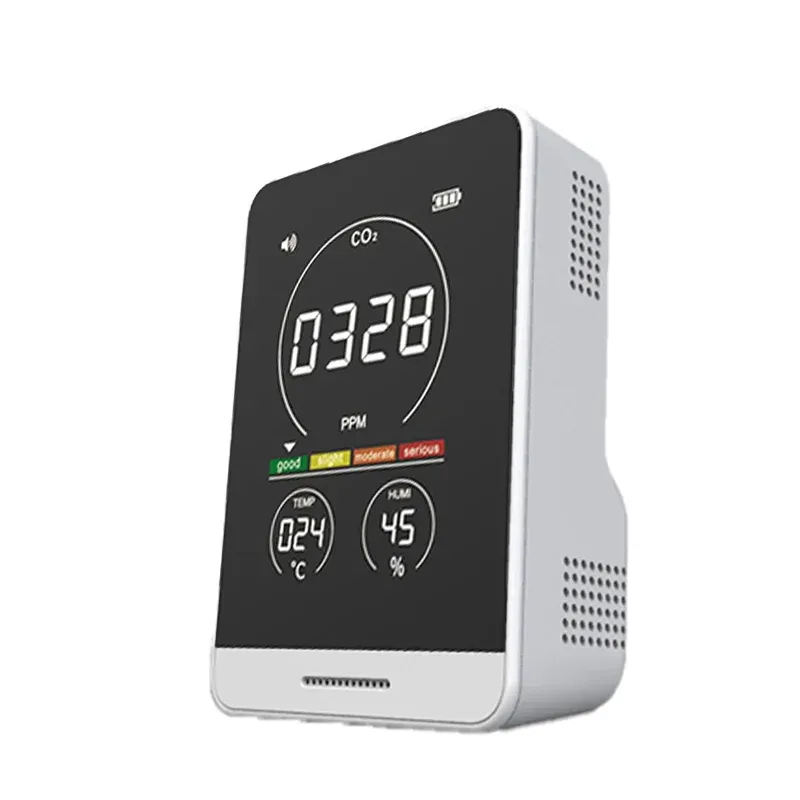
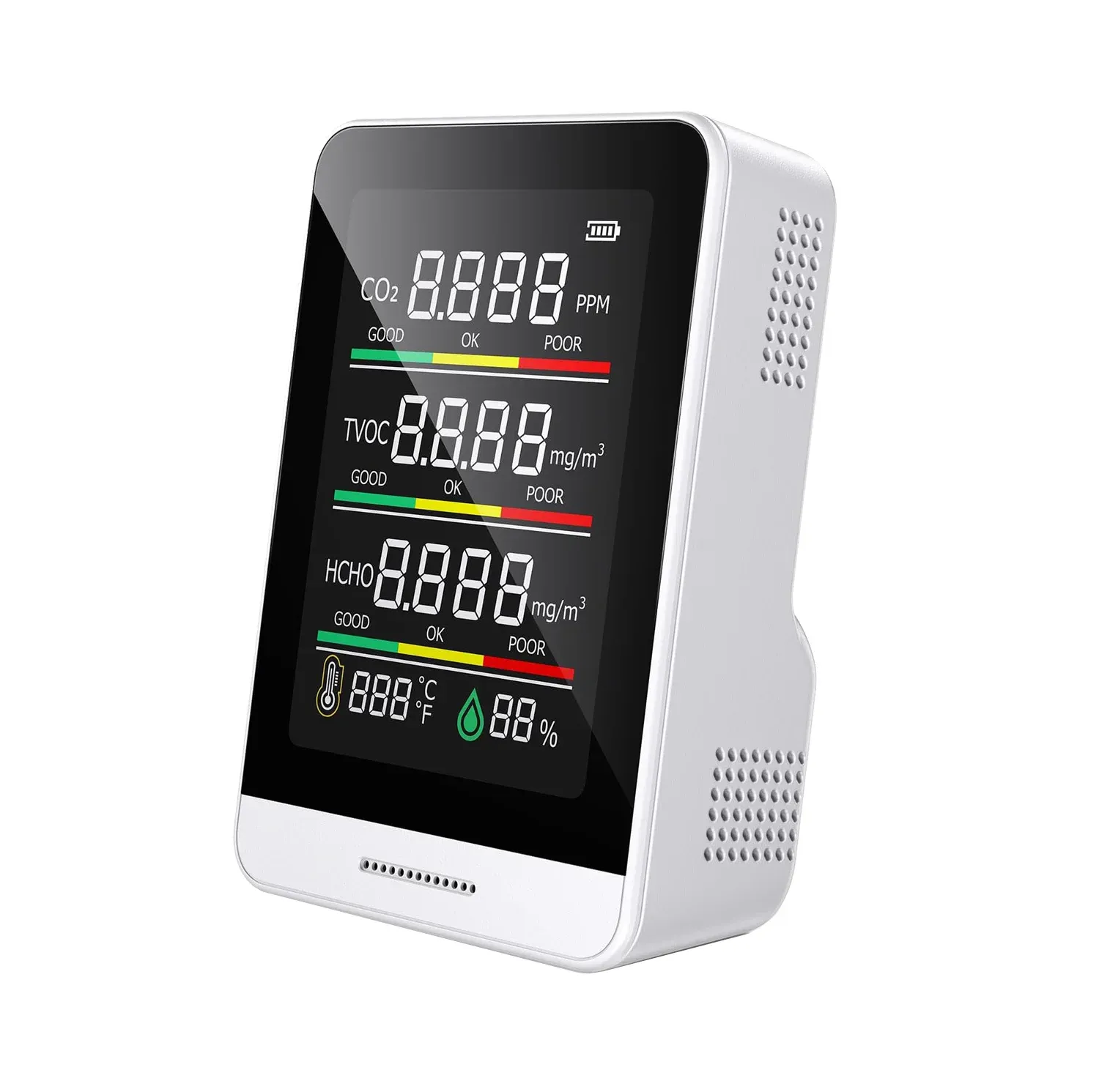
A semiconductor element reacts to gases at a heated surface, and the monitor turns that reaction into a number on screen. In the AK11T, that element tracks the rise and fall that tells you to open a window, which is the job it is built for in a classroom or meeting room. The same approach sits across all three gas channels of the AK3, keeping cost down while still showing the trend that matters — when a room needs airing.
The limitation is selectivity. Alcohol, solvents and cooking vapour move a semiconductor CO2 reading. Humidity swings, hand sanitiser and cleaning products leave an NDIR reading where it is, which is the difference the AK25AH is built around.
A semiconductor figure is therefore a trend indicator rather than a figure to quote. That is the honest way to position it: right for occupancy, not for certification.
- Semiconductor CO2 suits volume deployment where the question is "does this room need air?"
- It is the entry tier of a range, not the accuracy tier.
What infrared NDIR changes
NDIR reads how much infrared light the air absorbs, instead of how a heated surface reacts to it. That single change is what turns a trend indicator into a figure you can quote.
Two consequences matter to a buyer. First, infrared measurement does not age the way a semiconductor element does, so a figure taken next winter can be set against one taken today. Second, the reading is not thrown by alcohol gel, perfume or cleaning spray — the three things that most often corrupt a semiconductor reading.
NDIR responds to CO2 and nothing else, which is what makes a ventilation decision defensible. Where a semiconductor tells you the direction, NDIR gives you a number stable enough to put in a ventilation assessment and compare month to month.
The upgrade path inside one enclosure
The practical point for a distributor is that the sensor change often costs nothing in tooling. AK11T and AK11H share the same 98 × 32 × 67 mm shell and 50-per-carton spec; the semiconductor CO2 element becomes infrared NDIR. AK3 and the NDIR version AK4 share the same body, colour box and 50-per-carton pack, so a distributor carries both tiers on one pallet with a single freight calculation.
The same pattern repeats in the mini format. AK25A and AK25AH share an identical enclosure and packaging, so the accuracy tier arrives without a second carton specification to manage. In the AK16 platform, AK16A is the entry configuration of an enclosure that also carries AQI display, app connectivity, upgraded sensors and a CO channel.
- One enclosure, two CO2 tiers: AK11T and AK11H.
- One enclosure, two CO2 tiers: AK3 and AK4.
- One enclosure, two CO2 tiers: AK25A and AK25AH.
Where each tier belongs
Put the semiconductor tier where the decision is behavioural. AK11T's colour bar moves green to red as the level climbs, so occupants act on the band without learning what 1000 ppm means. AK3 puts five readings on their own colour status bands — CO2, TVOC and formaldehyde alongside temperature and humidity.
Put the NDIR tier where the number will be written down or repeated. AK8 carries a single CO2 value inside a green-to-amber-to-red arc, with temperature and humidity in two supporting circles, because a CO2 figure alone does not explain why a room feels stuffy. AK4 keeps TVOC, formaldehyde, temperature and humidity alongside the infrared CO2 channel — five readings in total, nothing traded away.
At the top of the range the distinction is stated explicitly. AK34 uses a True NDIR CO2 sensor and high-precision external sensors, and the source contrasts this with semiconductor-based sensors for reliable CO2 readings. It records both 24-hour and 15-day trend history, which is what makes a month-to-month comparison possible in one device.
Reading the rest of the screen
CO2 is rarely the only channel a buyer needs, and the sensor class differs per channel. The AK11P uses a laser scattering module with a fan-drawn sample path for PM2.5, the sensor class that produces a µg/m³ figure rather than an inferred estimate. The AK11C uses an electrochemical cell for formaldehyde — not a semiconductor element — which responds to formaldehyde specifically and holds its reading over months rather than hours.
On the multi-parameter platforms, particulates are split three ways. AK16A reports PM1.0, PM2.5 and PM10 separately by a laser module, because a single lumped particulate number hides which fraction is actually elevated. AK16C feeds those same three fractions into a composite index rather than averaging them away.
- CO2: semiconductor or NDIR, depending on the tier.
- PM2.5 and PM fractions: laser module.
- Formaldehyde: electrochemical cell.
- Carbon monoxide: electrochemical cell.
Specifying the CO2 channel
Ask what the reading will be used for. If it triggers a window being opened, a semiconductor element is the proportionate choice, and the AK11T is built for exactly that job. If it goes into a report, a comparison or a ventilation assessment, specify NDIR — the AK11H is the same shell with the infrared element in place of the semiconductor one.
Where the unit will sit in a room with cleaning products, hand sanitiser or cooking nearby, NDIR removes a known source of corrupted readings. Where the unit will be carried between rooms, the NDIR option exists in the smallest body in the range: AK25AH carries infrared CO2 at 98 g.
Both tiers can sit on one pallet. AK11H shares the same shell and carton spec as AK11T, which makes it the upgrade a distributor offers when a customer asks how accurate the number is.