

Start with the sensor class
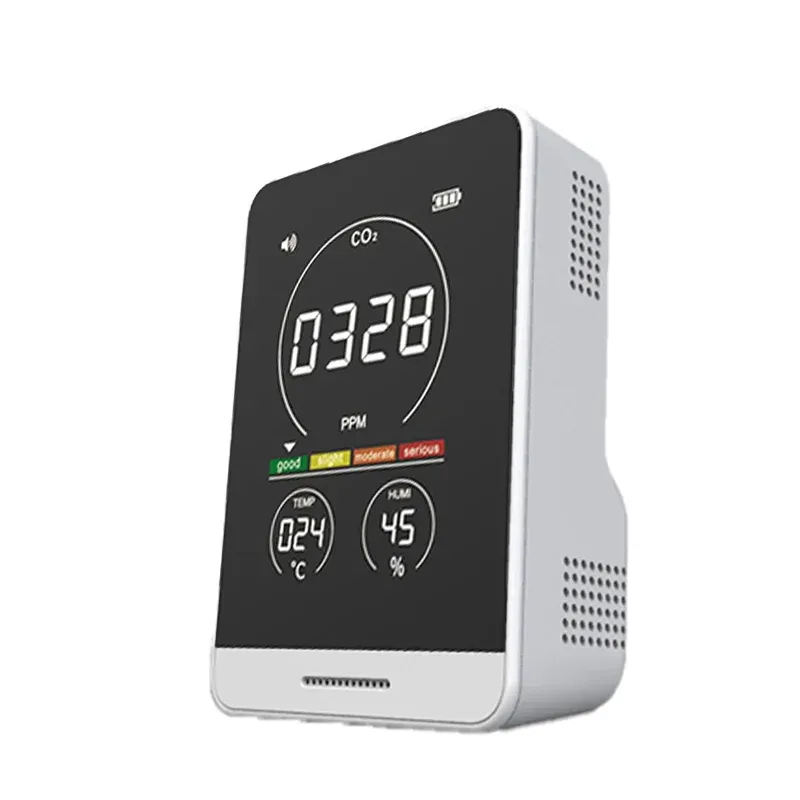
The first line to read is the sensing principle, because it decides what the number on the screen is worth. The AK11T tracks CO2 with a semiconductor element, which suits occupancy signalling rather than a figure you would put in a report. The AK11H uses an infrared NDIR element in the same enclosure, and infrared measurement does not age the way a semiconductor element does, so readings taken months apart stay comparable. The same split runs through the range: the AK3 and AK4 share one body, with the CO2 channel moving from semiconductor to NDIR, and the AK25A and AK25AH repeat that pattern in a mini body.
For formaldehyde, the AK11C uses an electrochemical cell rather than a semiconductor element, and that cell class is the one used for post-renovation testing. For particulates, the AK11P uses a laser scattering module with a fan-drawn sample path, which produces a µg/m³ figure rather than an inferred estimate. The AK16A reports PM1.0, PM2.5 and PM10 separately from a laser module, because a single lumped particulate number hides which fraction is elevated.
- Read the sensor class before the accuracy line.
- Check whether the CO2 channel is semiconductor or NDIR.
- Confirm whether particulates are split into three fractions or lumped.
Match the parameter list to the job
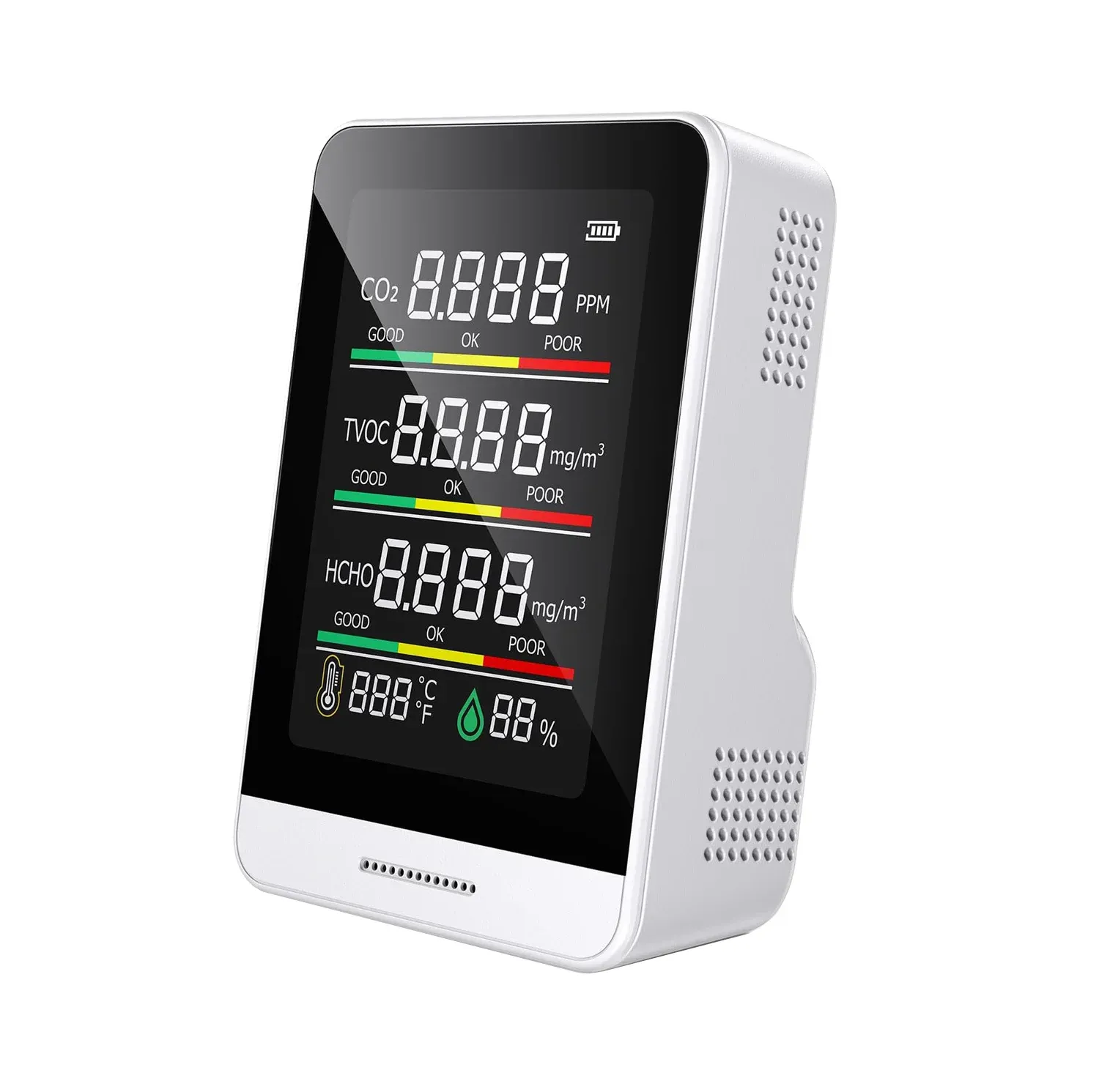
A model that measures nine parameters is not automatically better than one that measures two. The AK18B carries CO2 and TVOC in a 39 g body, so it answers two questions: how many people the ventilation is failing to keep up with, and what the room's materials are adding. The AK29 adds radon to the particulate, CO2, VOC and formaldehyde set, and the AK36 covers temperature, humidity and heat index in a sealed enclosure.
Where a single question matters, single-purpose instruments are easier to specify. The AK8 puts one CO2 value inside a colour arc, with temperature and humidity underneath. The AK11C carries formaldehyde with temperature and humidity, because formaldehyde release rises with both. The AK18A measures CO only, with an electrochemical cell.
Read the display, logging and alarm lines together
The display tells you who the device is for. The AK16C collapses eight readings into a single index figure while keeping the underlying values on screen, so a guest and a facilities manager can read the same unit. The AK22A tiles six values with equal weight for a technician scanning for the one that moved, while the AK22B puts PM2.5 in a central ring for a lobby or reception desk. The AK23A separates particulates and gases into two dials, and the AK23B gives PM2.5 the centre at several times the size of anything else.
Logging decides whether the device produces a finding or a recollection. The AK33 stores its own record on board, so it logs whether anyone is present or not. The AK34 records both 24-hour and 15-day trend history. Alarms are a separate line: the AK17 sounds a buzzer when concentration reaches the stated threshold, the AK18A sounds and shows an alert when the reading crosses its threshold, and the AK16D-CO carries an on-screen alert for continuous sited monitoring.
- Check whether the display is a single number, a grid or a dial.
Power, enclosure and footprint
Power determines where a unit can live. Mains-powered models run indefinitely without a charging routine, which suits overnight and winter risk periods. Battery models trade that for placement freedom: the AK30 carries a self-dimming display for bedrooms and nurseries, and the AK35 runs a 3500 mAh battery for up to 15 hours of cordless use. The AK36 uses two AAA cells inside a sealed enclosure, so nothing has to be opened to keep it running.
Footprint matters for mixed deployments. The AK25A fits a nightstand, a shelf or a car cup holder at 98 g. The AK22A and AK22B share one enclosure and one carton specification, so two display layouts come from one tooling set. The AK23A and AK23B repeat that arrangement.
What to request from the supplier
Ask for the spec sheet of each model you are considering, and read the certification line there rather than assuming it.
Where a model shares an enclosure with another, ask for both spec sheets together so you can see exactly which lines differ and which are identical.