

Start With the Question, Not the Sensor Count
A trend indicator tells occupants when to open a window; an assessment figure has to be stable enough to quote and compare over months. Those are different instruments, and the source material draws the line at the sensing element rather than the enclosure.
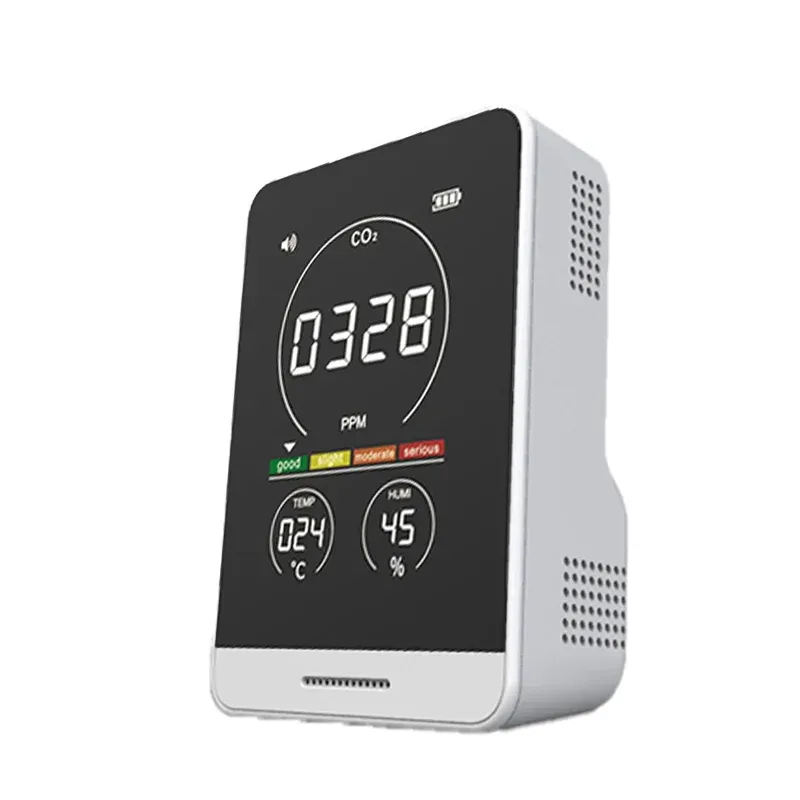
CO₂ is the clearest example. The AK11T uses a semiconductor element to track the rise and fall that signals a room needs airing, and the AK11H puts infrared NDIR into the same 98 × 32 × 67 mm shell and 50-per-carton spec. Infrared measurement does not age the way a semiconductor element does, so a figure taken next winter can be set against one taken today, and alcohol, solvents and cooking vapour move a semiconductor CO₂ reading but do not move this one.
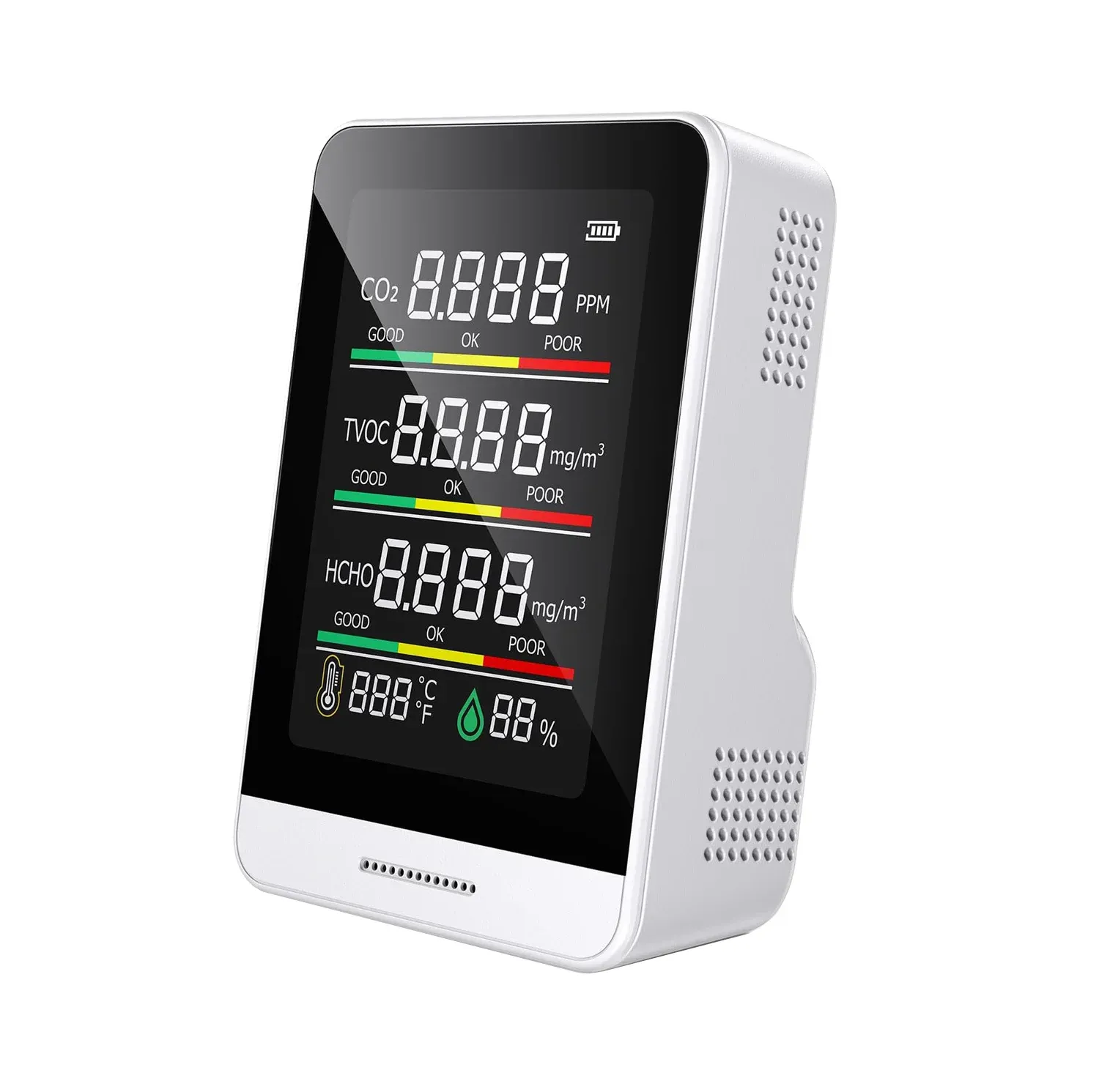
The AK3 carries semiconductor sensing across its gas channels, and the AK4 shares its body, colour box and 50-per-carton pack with the CO₂ channel upgraded to infrared NDIR. NDIR reads how much infrared light the air absorbs rather than how a heated surface reacts to it, and it is not thrown by alcohol gel, perfume or cleaning spray.
- Single-purpose CO₂ with an arc display: AK8
- CO₂ plus gases in a pocket body: AK3 and AK4
- CO₂ only, in the AK11 shell: AK11T and AK11H
Particulates Need Their Own Instrument
Particulate measurement is a separate purchase from gas measurement, and the source material treats the sensing method as the deciding factor. The AK11P uses a laser scattering module with a fan-drawn sample path, the sensor class that produces a µg/m³ figure worth acting on rather than an inferred estimate. It is a single-purpose device for auditing a purifier, judging filter change intervals or checking whether a window should stay shut, and the reading follows in real time because particulate levels move the moment a door opens or a candle is lit.
Where a programme needs the particulate fractions separated, the AK16A reports PM1.0, PM2.5 and PM10 separately by a laser module, on the grounds that a single lumped particulate number hides which fraction is actually elevated. The AK22A and AK22B carry the same eight parameters and the same laser particulate split in a 166 × 108 mm body, and the difference between them is entirely in how the information is presented — a grid for scanning every value, a dial for a lobby or reception desk.
Formaldehyde is its own channel. The AK11C uses an electrochemical cell rather than a semiconductor element, responds to formaldehyde specifically, holds its reading over months rather than hours, and is the sensor class used for post-renovation testing. Temperature and humidity sit alongside it because formaldehyde release rises sharply with both, so the two readings explain why a level moved.
Match the Enclosure to the Room
How a monitor is read decides which face to specify. The AK23A splits particulates and gases into two dials with a six-step colour and expression scale beneath, so a guest interprets the air without interpreting the numbers. The AK23B puts PM2.5 at several times the size of anything else, readable from a distance no dial layout matches, and shares the enclosure, packaging and 32-per-carton spec with the AK23A.
The AK28A replaces menus with four dedicated keys for clock, alert, brightness and power, and uses a moulded rear wedge that sets the screen at a fixed reading angle without a fold-out leg to snap off. The AK16A folds flat for travel and angles for desk viewing, and its eight readings each carry a colour band beneath them so nothing needs checking against a reference table. The AK16C adds a 0–500 index on top of the same eight underlying values, so a facilities manager and a guest can read the same device.
- Large-screen grid for technicians: AK22A
- Large-screen dial for public-facing rooms: AK22B
- Fixed-angle desk unit with physical keys: AK28A
- Slim desktop with a fold-out stand: AK16A
Power, Logging and Placement
Power strategy follows placement. The AK32A runs on mains indefinitely, so it never depends on someone remembering to charge it, and it uses a dedicated electrochemical CO cell. The AK18A carries an electrochemical cell in a 39 g body with a rechargeable 500 mAh cell charged over USB-C in about an hour. The AK19 measures ionising radiation and shows both the instantaneous reading and the running total, because a brief high reading and a long low exposure are different problems.
Logging separates a finding from a recollection. The AK33 stores its own record on board, so it logs whether anyone is in the room or not, and it weighs 173 g at 25 mm thick. The AK34 records both 24-hour and 15-day trend history, which makes pollution patterns and daily changes comparable.
For continuous overnight use, the AK30 drops its own backlight as the room darkens, using an ambient light sensor, and runs eight hours of standby from 5000 mAh. The AK36 is the only sealed enclosure in the catalogue, rated IP65 for water and dust, and runs on two AAA cells so nothing has to be opened.
Certifications and Programme Fit
Ask for the spec sheet of every model you shortlist and confirm the entries against your own market requirements before you commit.
Beyond that, check the platform economics. The AK11 family shares one shell, colour box and 50-per-carton spec across its variants, so a mixed pallet ships as a single line item. The AK16A and AK16C share an enclosure, packaging and 30-per-carton spec, giving two tiers from one production line. The AK23A and AK23B share tooling and carton spec, and the AK28A mixes freely on a pallet with the AK23 despite a different body. The AK18 range spans five sensor configurations on one carton spec.
- Confirm certifications per model on its spec sheet before specifying.
- Check which models share an enclosure and carton spec to simplify pallets.