
Choosing the CO2 sensor class first
The first decision is the sensing element, because it sets what the number can be used for. A semiconductor CO2 element tracks the rise and fall that tells you to open a window, which is what a classroom needs; NDIR infrared is the step that turns a trend indicator into a figure you can quote.
Infrared measurement does not age the way a semiconductor element does, so a figure taken next winter can be set against one taken today. It is also unaffected by what else is in the air — alcohol, solvents and cooking vapour move a semiconductor CO2 reading, and they do not move an infrared one.
Several models carry infrared CO2 in the same shell as their semiconductor sibling, so the accuracy tier does not force a new enclosure, carton or installation footprint.
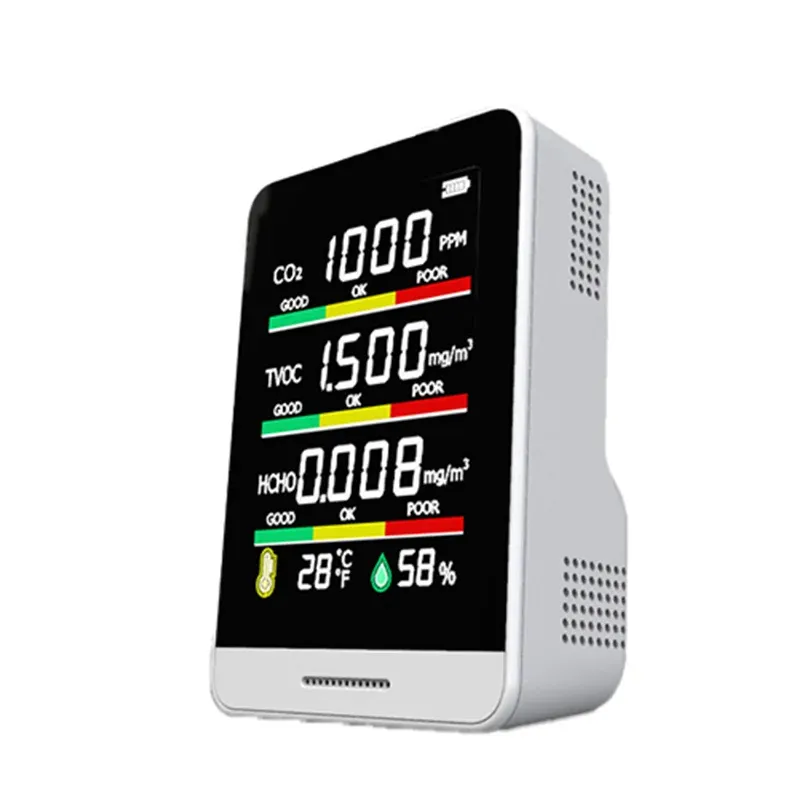
- AK11T: semiconductor CO2, colour bar readout.
- AK11H: infrared NDIR CO2 in the same shell.
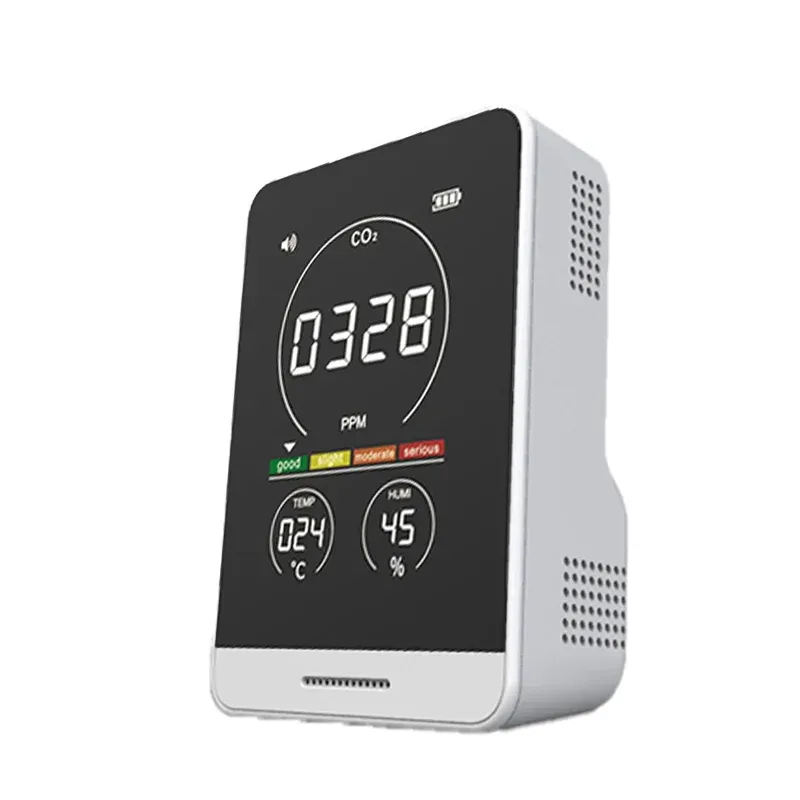
- AK8: infrared NDIR, single CO2 value in a green-to-amber-to-red arc.
- AK4 and AK25AH: infrared CO2 in the AK3 and AK25A bodies respectively.
Making the reading legible to staff
A classroom monitor is read by people who will not study a manual. The colour bar under the digits on AK11T moves green to red as the level climbs, so occupants act on the band without learning what 1000 ppm means.
The AK8 puts one CO2 value inside a green-to-amber-to-red arc that fills the screen, so the band registers from across a meeting room before you read the digits. Temperature and humidity sit underneath, because a CO2 figure alone does not explain why a room feels stuffy.
Where a room carries more than CO2, the AK16C collapses eight readings into a single 0–500 index figure with a colour scale, while all eight underlying values remain on screen — so a classroom assistant and a facilities manager can read the same device.
Matching the model to the room
Not every school space needs the same parameter set. Match the configuration to what the room actually fails on.
- Classrooms and halls: CO2 plus temperature and humidity is the core set; AK11H or AK8 cover it.
- Rooms with new furniture, boards or adhesives: formaldehyde release rises sharply with temperature and humidity, so a unit that reads HCHO alongside both explains why a level moved. AK11C is single-purpose for that window.
- Rooms where particulates matter: AK11P reports a PM2.5 figure from laser particle counting, with a fan-drawn sample path, and responds in seconds when a door opens or a purifier starts.
- Full-building surveys: AK33 measures all eight parameters at 173 g and stores its own history on board, so a walk-round record exists whether or not anyone was in the room.
- Science labs and boiler rooms: AK16D-CO adds an electrochemical CO cell, bringing the count to nine measured parameters.
Planning the rollout across a site
Mixed deployments are simpler when the units share tooling. The AK11 family shares one shell, colour box and 50-per-carton spec across AK11T, AK11H, AK11C and AK11P, so a mixed pallet ships as a single line item.
The AK16 platform works the same way: AK16A is the entry configuration of an enclosure that also carries AQI display, app connectivity, upgraded sensors and a CO channel, and AK16C adds the index without changing the enclosure, packaging or 30-per-carton spec.
For a large site, the AK3 and AK4 share a body, colour box and 50-per-carton pack, and AK4 carries the infrared CO2 upgrade — a distributor carries both tiers on one pallet with a single freight calculation.
Power, runtime and siting
How a monitor is powered decides where it can live. The AK11 family runs a 1200 mAh cell for 6–8 hours with USB-C charging in roughly three hours, which covers a school day without a socket.
The AK16 models run a 2000 mAh cell for six hours cordless with a three-hour USB-C charge; the fold-out stand angles the panel for desk viewing and folds flat for travel.
Where a monitor must run continuously rather than be picked up and put down, the AK30 carries 5000 mAh and eight hours of standby, and an ambient light sensor drops the backlight as the room darkens.
The AK34 records both 24-hour and 15-day trend history, which makes pollution patterns and ventilation habits visible over time rather than in a single spot reading.
What to confirm before ordering
Two practical checks belong in every programme specification.
First, confirm the sensing class for each room against the model's own description, since the CO2 channel is the parameter most often assumed rather than checked.
Second, confirm each model's certifications on its own product spec sheet rather than from a range-level summary, and confirm the carton specification for each model you plan to mix.
- Check the spec sheet of each model for its certifications.
- Check carton quantity and outer dimensions per model before planning pallet loads.
- Check runtime and charge time against how the room will actually be used.